
Victorian tiled floors are a wonderful feature of many period properties throughout Merseyside, particularly in established residential areas such as Blundellsands, Crosby and Waterloo. These traditional floors were designed to be both attractive and hard-wearing, with intricate geometric patterns and contrasting colours that create an impressive entrance to a home.
However, after decades of foot traffic, ingrained dirt, cleaning products and general wear, even the most beautiful Victorian tiled floor can become dull and look tired. Fortunately, with the correct specialist cleaning and restoration techniques, these original floors can often be brought back to life without the need for costly replacement.
The project at a property in Blundellsands involved deep cleaning the tiles, removing stubborn surface contamination using specialist milling pads, and applying a protective sealer to enhance the appearance of the floor and make future maintenance easier.
Restoring an Original Victorian Hallway Floor in Blundellsands
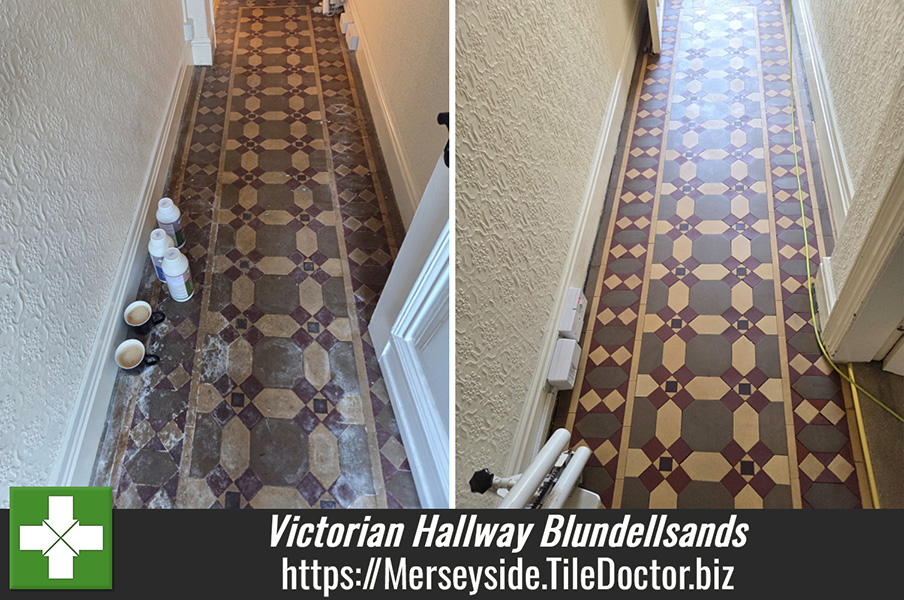
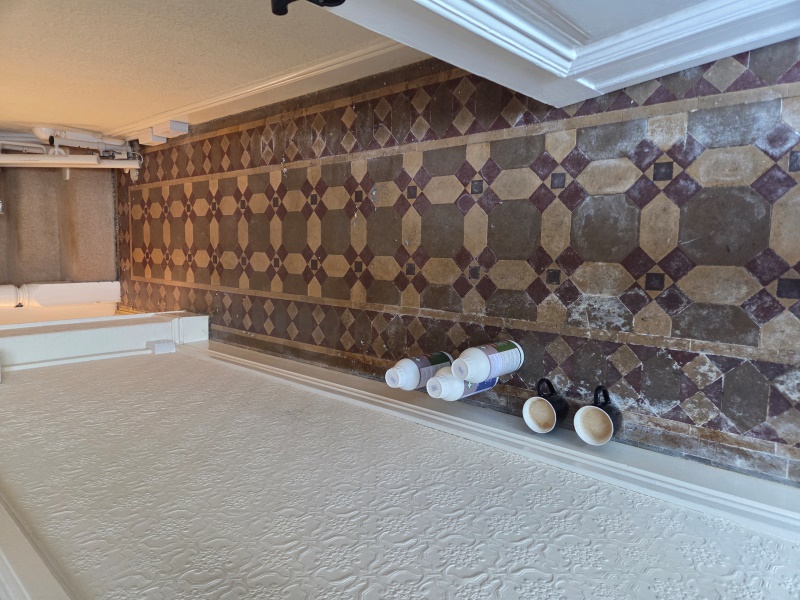
The hallway featured an attractive geometric Victorian tiled floor with a repeating pattern of dark grey, burgundy and cream-coloured tiles. The design included a decorative central section framed by matching patterned borders running along both sides of the hallway.
These traditional geometric floors are characteristic of Victorian and Edwardian properties throughout Merseyside and are increasingly valued by homeowners looking to preserve the original features of their homes.
Unfortunately, the floor had lost much of its original appeal. Years of accumulated dirt and surface contamination had dulled the colours, while areas of whitish residue and staining were particularly noticeable across sections of the tiles.
As the before photograph shows, the floor appeared uneven in colour, with the decorative pattern partially obscured by the surface deposits.
The objective was to remove the contamination, improve the overall appearance of the tiles and protect the restored surface while retaining as much of the original character as possible.
Rather than replacing the floor, which would have meant losing an important period feature, the homeowner opted for professional Victorian tile restoration.
Step 1 – Deep Cleaning the Victorian Floor with Tile Doctor Oxy-Gel
The restoration began with a thorough deep clean using Tile Doctor Oxy Gel, a specialist alkaline-based cleaning product designed to tackle stubborn dirt and contamination on tiled surfaces.
Without an active sealer Victorian floor tiles can accumulate years of ingrained dirt, particularly in hallways where outdoor debris is regularly carried into the property on footwear.
The gel formulation of Oxy-Gel makes it useful for targeted cleaning, allowing the product to remain in contact with the surface while it works on accumulated soiling. During this stage, the cleaner was used to help loosen and remove dirt from the tiles in preparation for the more intensive restoration work.
The floor was also treated where appropriate with Tile Doctor Acid Gel, which was used to help address cementitious residues and mineral deposits.
Acid-based cleaning products can be particularly useful when dealing with certain types of mineral contamination, but they must be selected and applied carefully to ensure compatibility with the tiles and surrounding materials.
Using the appropriate cleaning products helped prepare the floor for the next stage of the restoration.
Step 2 – Restoring the Victorian Tiles with Specialist Milling Pads
Once the initial cleaning had been completed, attention turned to the more stubborn surface contamination that could not be adequately addressed through chemical cleaning alone.
For this stage, Merseyside Tile Doctor used specialist 100-grit and 200-grit milling pads to mechanically work the surface of the Victorian tiles. Milling pads are abrasive restoration tools that can be used by experienced professionals to remove persistent surface deposits and refine suitable tiled surfaces.
The process began with a 100-grit pad, which applied with water for lubrication provides the more intensive level of abrasion required to tackle the remaining contamination. After rinsing and extracting the floor was then worked with a finer 200-grit milling pad to further refine the surface and improve its overall appearance.
This progressive approach helped remove unwanted surface material and reveal the underlying colours of the original tiles.
Mechanical restoration requires care, particularly when working with older Victorian floors. The aim is to remove the unwanted contamination without unnecessarily damaging the historic tiles or compromising their decorative pattern. By using the correct equipment and techniques, Merseyside Tile Doctor was able to achieve a significant improvement in the floor’s appearance.
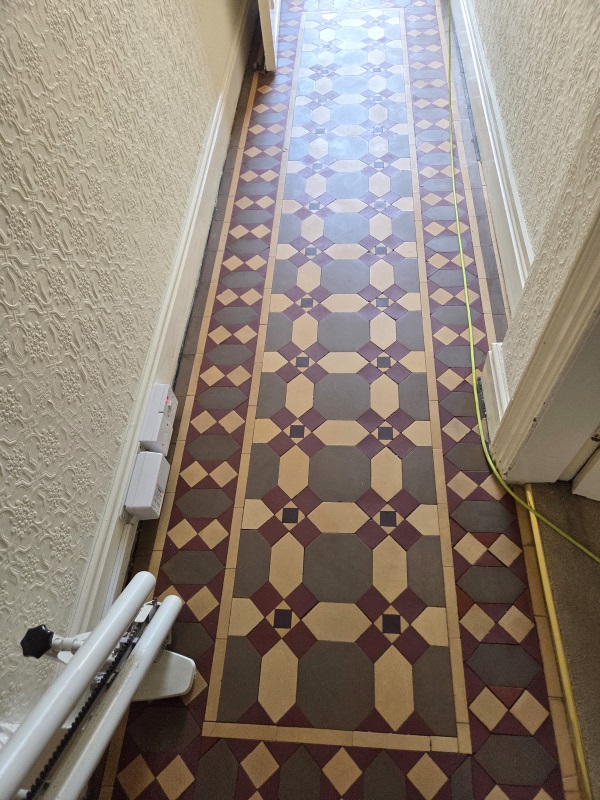
The dark grey tiles became more defined, the burgundy sections regained their rich colouring, and the cream-coloured geometric details stood out much more clearly. The intricate pattern, which had previously appeared faded and obscured, was once again a prominent feature of the hallway.
Step 3 – Thorough Rinsing and Preparing the Floor for Sealing
Following the mechanical restoration, the entire floor was thoroughly rinsed to remove the remaining cleaning solutions, loosened dirt and residues generated during the milling process.
This is an important part of any professional Victorian tile restoration. Leaving cleaning residues on the surface can affect the final appearance of the tiles and may interfere with the performance of a subsequently applied sealer.
Once the cleaning and rinsing were complete, the floor was allowed to dry fully. Victorian floor tiles must be sufficiently dry before sealing, as trapped moisture can affect the appearance and performance of certain sealing products.
Older properties can sometimes present additional challenges because traditional floors may not have the same damp-proofing arrangements as modern installations. For this reason, the drying stage should never be rushed, and the condition of the floor needs to be considered before selecting and applying a protective sealer.
With the Blundellsands hallway cleaned, restored and fully dried, it was ready for the final stage of the project.
Step 4 – Sealing the Victorian Tiles with Tile Doctor X-Tra Seal
To complete the restoration the floor was sealed with Tile Doctor X-Tra Seal which is an impregnating protective tile sealer that’s externally rated and so ideal for a hallway.
Sealing is an important consideration when restoring traditional Victorian floor tiles, as many older tiles have a degree of porosity and can absorb moisture and everyday dirt. The purpose of the sealer is to provide protection against general soiling ensuring dirt remains on the surface where it’s easier for the homeowner to clean away.
The sealer also helps bring out the appearance of the restored tiles, making the contrasting colours and geometric design more visually appealing.
The Finished Result – A Beautiful Victorian Hallway Restored
Once complete the rich burgundy border tiles now provide a striking contrast against the dark grey and cream-coloured central design, while the decorative geometric pattern is much easier to appreciate.
These floors were built to last, and even when they appear badly worn or heavily soiled, they still have considerable potential to improve their appearance through specialist treatment.
For aftercare I recommended the use of Tile Doctor Neutral Tile Cleaner, it’s ph neutral formula makes it safe to use on sealed tiles. Many of the products you see advertised on the TV are simply too strong for use on a sealed floor and will lead to the premature degradation of the sealer.
Never use a steam cleaner or strong cleaning product on sealed tile or stone as this will reduce the life of the sealer. We recommend using a specialist tile cleaning product such as Tile Doctor Neutral Tile Cleaner or Stone Soap for the regular cleaning of sealed surfaces. if you do use another product always read the label first, most supermarket tile cleaners are only suitable for use on Ceramic Tile or Vinyl.